The land
The Cilento, Vallo di Diano and Alburni National Park
A simple beauty that goes straight to the heart
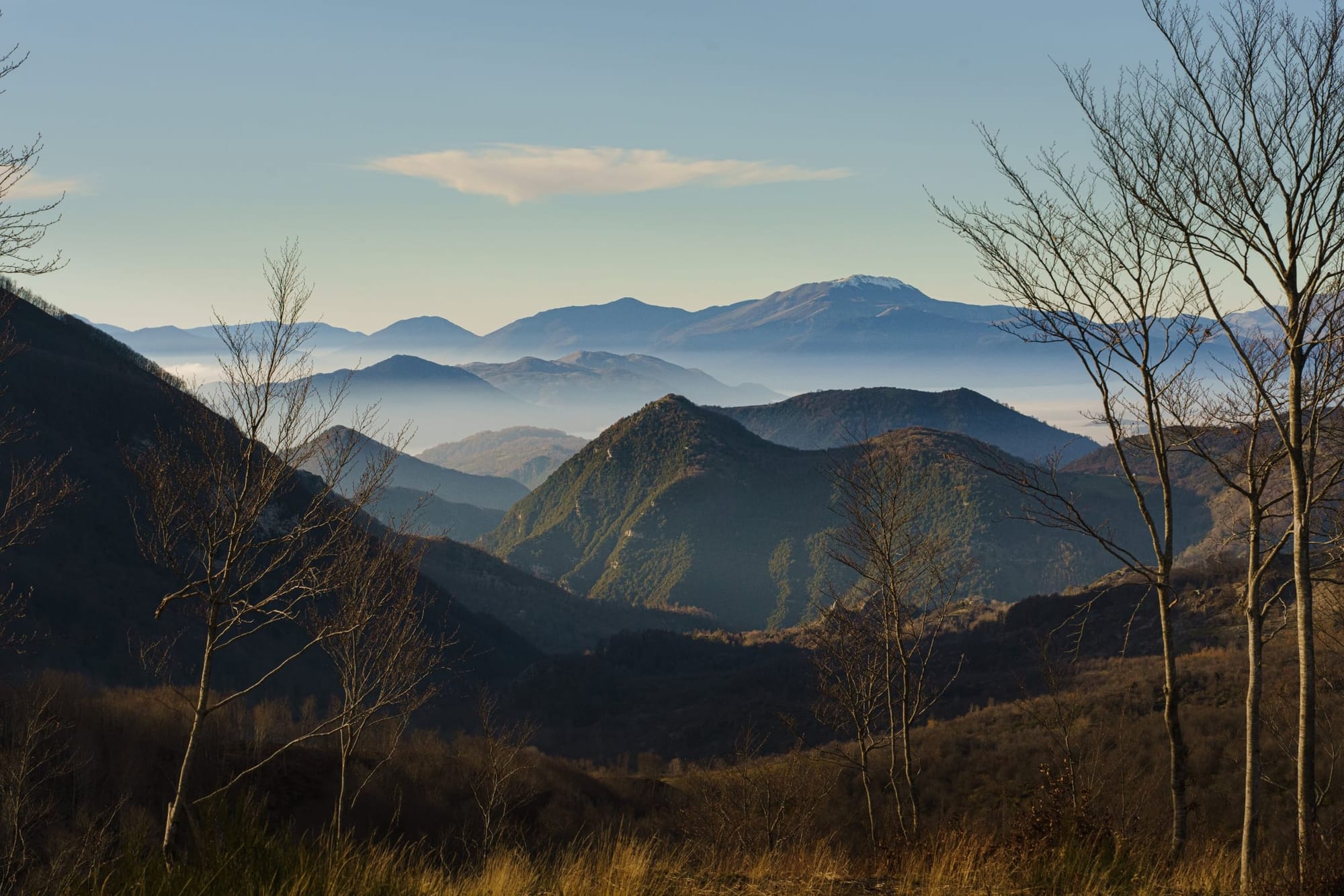
The Cilento has a rustic beauty, very different from the more cinematic beauty of the Amalfi Coast: small villages, hills planted with olive trees, wild mountains and a crystal-clear sea, with many beaches awarded the Blue Flag.
In the morning the haze turns the mountains blue, layering their outlines like paper cut-outs in a collage. In the evening, once the humidity has lifted, the light becomes clear and transparent, and the sunsets bring extraordinary colours.
In 1998 UNESCO recognised this land as a World Heritage Site, not only for its natural beauty but for the value of a landscape that tells thousands of years of history and has been a meeting place of different peoples and civilisations: Greeks, Lucanians, Etruscans and Romans.
From this blend of cultures, knowledge and traditions comes a food culture whose best-known expression is the Mediterranean Diet, and a way of working the land that still gives us products with ancient roots, such as Aglianico wine and olive oil, which has been produced here for almost three thousand years.
Magna Graecia
Elea, today Velia: the city of philosophers
A few kilometres from our olive groves lie the remains of Elea, the ancient city founded around 540 BC by Greek colonists from Phocaea and later called Velia by the Romans.
Elea was home to the Eleatic school of philosophy: here Parmenides, the first to question the nature of being, and his pupil Zeno, famous for his paradoxes, were born and taught. Their thought shaped the history of Western philosophy.
The olive tree arrived with the Greeks. In Magna Graecia its cultivation spread together with the techniques for pressing oil, and it has never left these hills since. Salella, the variety we grow, is one of the historic cultivars of the Cilento.
The Park
One of the largest national parks in Italy
The Park was established in 1991 to protect the area from property speculation and mass tourism; the body that manages it, founded in 1995, is based in Vallo della Lucania.
It covers about 181,000 hectares and includes, wholly or in part, 80 municipalities: from the Sele plain to the border with Basilicata, from the Alburni Mountains and Monte Cervati, the highest peak in Campania, to the coasts of Punta Licosa and Palinuro. A land of mountains, rivers, woods and Mediterranean scrub, where olive-covered hills run down to the sea.
- 1991
- Establishment of the National Park
- 181,000 ha
- Protected area, approx.
- 80
- Municipalities included, wholly or in part
UNESCO
World Heritage
UNESCO recognises the Cilento as a cultural landscape of outstanding value: in prehistory and in the Middle Ages its mountain ridges were a route of communication between the Tyrrhenian and the Adriatic, leaving a landscape that still tells this story today.
- 1997
- Biosphere Reserve, MAB programme
- 1998
- World Heritage Site, with Paestum, Velia and the Certosa di Padula
- 2010
- First Italian national park to become a UNESCO Geopark
Mediterranean Diet
The land of the Mediterranean Diet
In 2010 UNESCO inscribed the Mediterranean Diet on the list of the Intangible Cultural Heritage of Humanity. For Italy, the emblematic community chosen was the Cilento, with Pollica.
It was here, in Pioppi, that the American physiologist Ancel Keys lived for many years, studying the diet and longevity of the people of the Cilento and giving a name to a way of life built on grains, pulses, vegetables, fish and extra virgin olive oil.
Olive oil is one of the pillars of this tradition: we make it as it has always been made, with one difference — organic certification at every stage.
Find out more
Useful links
- Cilento, Vallo di Diano and Alburni National Park Authority
Official website of the Park - UNESCO – World Heritage
The listing for the Cilento and Vallo di Diano site, with Paestum, Velia and the Certosa di Padula - The Mediterranean Diet – UNESCO Italy
Its recognition as Intangible Heritage - Mediterranean Diet Study Centre, Pollica
The emblematic community of the Cilento - Acquavella, our village
History and places of the village where our oil is born
From the Cilento to your table
Every bottle carries this land with it: Salella olives, early harvest, cold pressed, certified organic.